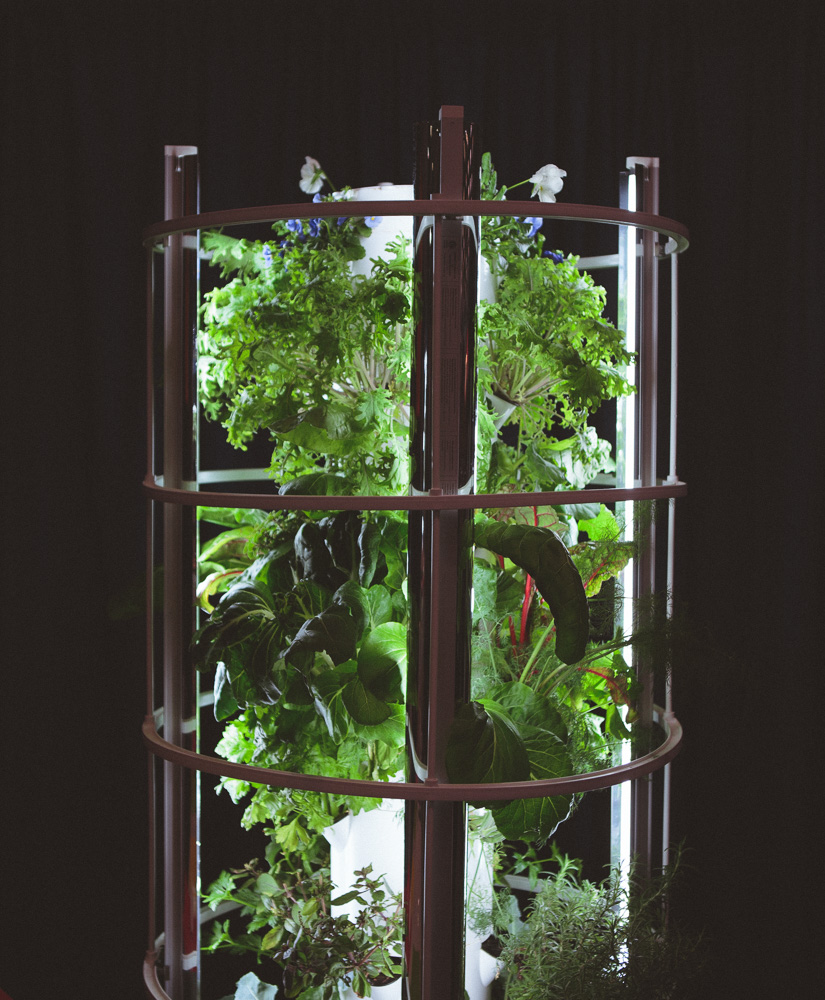
Starting our Garden! Cultivating plants and minds in Northfield, MN.

Our garden, which is funded by Kitchen Garden Laboratory, is two weeks in the making!

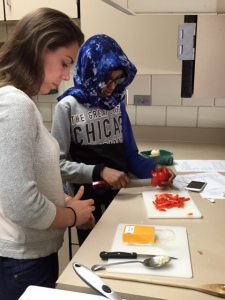
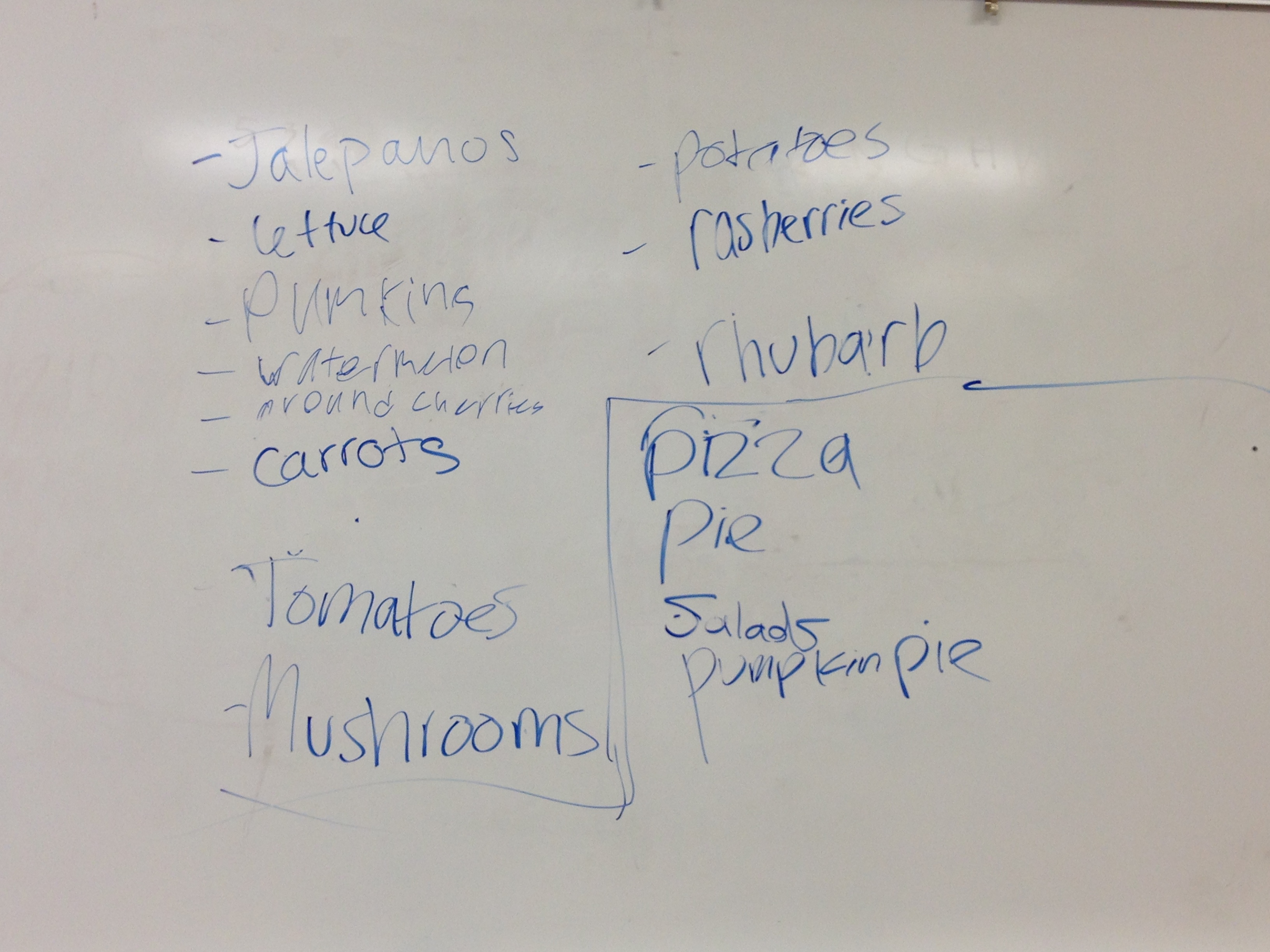
Last week was our first garden class at the Northfield Middle School and we got to meet some of the students who will be the founding gardeners of the first ever middle school garden in Northfield. We began by talking a bit of gardening and the conversation soon progressed to what types of plants to grow—from jalapenos to rhubarb, there were great ideas! After talking plants, it wasn’t long until the conversation hopped to what we we’d want to cook with these crops—pizza, pie, and salads topped the list! Following this brainstorming, it was time to get our hands dirty and plant some seedlings—soon we’ll have peas and beans to snack on!

This week, for our second garden class, we explored the process of planning a garden—square foot garden style. There were three students and it was awesome to have some 1-1 time! Because of this, we were able to stray from the lesson and brainstorm as a team at the beginning of the class. After bouncing ideas back and forth (everything from trellises to solar cells), students designed their own 2×2 raised bed, calculating the number of plants that could fit depending the required spacing. Once the individual square foot beds were designed, we came together as a group and planned a raised bed as a team—using vegetables as stamps to decorate our design! As class ended, our focus turned towards the next big topic—what to call the garden! Such an important decision couldn’t be decided in a split second, so you’ll have to wait till next week to hear more!

garden3 garden2 garden1

Erin Roth ’16, Young Chefs Garden Director

Hot Tempered: Week 4, Faribault, MN

When you are dealing exclusively with chocolate, it is nearly impossible to go wrong. This week at Young Chefs, we made no exceptions to this rule as we investigated crystalline structure and formation with regards to dark chocolate. As we transformed solid chocolate into its delectable liquid form and back again, we not only developed an understanding of molecular interactions, but we also explored the the complex process of chocolate production.
From a culinary angle, the lesson took no convincing. The kids were ecstatic upon discovering that we would be melting chocolate and then be dipping an array of fruits, pretzels and marshmallows into the sweet, rich product. Before we began the cooking process, we passed around a square of dark chocolate for them to taste and describe. Their enthusiasm was tempered slightly because the dark chocolate was “bitter”, “gross” and was not “normal good chocolate”. Despite this, they were able to describe their samples as creamy, smooth and shiny. These descriptors provided the perfect segue into the science portion of the lesson.
As it turns out, chocolate is a fairly complex substance. Its principle ingredients are cocoa butter and fat crystals. The fat crystals can align in six different ways which means that the chocolate is said to have six distinct crystal states. Each of these states has unique chemical and physical properties including shine, hardness and melting point. Crystal state 5 is a highly ordered state and, as a result, if the chocolate is in this form, it is glossy, smooth and hard. It also melts at 34°C which is a higher temperature than most most of the other crystal states. As it turns out, it is difficult to make chocolate harden into this desirable crystalline structure. To do so, the chocolate must be melted to exactly 34°C, then removed from the heat to harden. If the chocolate is warmed up any more than this, the molecules move too quickly to have order when they are suddenly removed from the heat.
With the goal of 34°C, we began to melt chocolate over a double boiler. As we stirred, we paid close attention to the thermometer. Within a minute, the chocolate reached the ideal point and we removed a spoonful and allowed it to harden. We continued to heat the rest of the chocolate so that we could compare the crystals that from from warmer melted chocolate to those made with 34°C chocolate. As the chocolate heated, we had a chocolate exploratorium. We had a cocoa pod, cocoa nibs, cocoa powder, cocoa butter and, finally, a bar of chocolate so that they could see how the chocolate becomes the substance that we know and love. This part of the lesson went over extremely well and the chefs loved tasting the chocolate at the different phases of production.
By the time the exploratorium was done, the two samples of the chocolate had hardened and they were able to compare the chocolate that had been melted at different temperatures. Though the differences in the appearances were subtle, it was clear that the chocolate that had been warmer melted much more quickly on the palm of their hands.
Using the remainder of the melted chocolate, we launched into the best part of the lesson— the eating phase. Using strawberries, bananas, mangoes, raspberries, blueberries, pretzels, marshmallows and pears as vehicles, the students scarfed down the chocolate, regardless of the fact that it was “disgusting” “weird” dark chocolate.

Written by Rebecca Fairchild, ’18

IMG_2776 IMG_2772 IMG_2781 IMG_2774 IMG_2771

Caramelizing Creativity: Week 3, Faribault, MN

As one should probably expect, there was a decent amount of skepticism at Faribault this week when we announced that we would be eating onions. Students recoiled at the thought of tasting the strongly-flavored, tear-inducing vegetable. In their raw form, we explained, onions are not particularly appetizing. However, it is possible to caramelize them so that they are sweet and delicious. It was this golden form that we we dealt with this week.
Last week, we used popcorn to focus on the concept of physical changes. To complement this lesson, this week we explored chemical change associated with caramelization. Caramelization is a process in which the long polymers of sugar are broken into monomers, which we perceive to be sweet. This is classified as a chemical reaction, and, for a chemical reaction to occur, molecules must bump into one another. With this knowledge, we asked the students to ponder the effect of heat energy on molecular collisions. Intuitively, it made sense to them that warmer molecules would move faster and bump into each other more; this would make for a faster rate of reaction. Though heat does influence reaction rate, we explained that there are other factors, such as PH, that also impact the rate of reaction. Under normal conditions, onions take a very long time to caramelize. However, with the addition of the a pinch of baking soda, the reaction moves much more quickly. This happens because the baking soda changes the PH of the system and acts as a catalyst for the reaction.
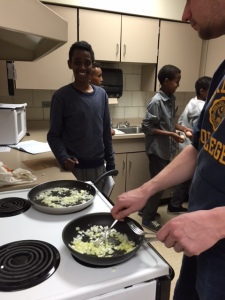
We then broke into small groups to see these reactions play out in real life. To better observe the difference between the catalyzed and un-catalyzed reactions, we heated up two pans of onions— one with baking soda and one without. As the reaction was underway, the students remarked at how the onions with baking soda were so much more yellow and got softer much faster than those without the catalyst. While the onions cooked, we moved on to the part of the lesson that required a little more culinary creativity— omelet making. With the caramelized onions, peppers, tomatoes, zucchini, jalapeños, spinach, avocado, mushrooms, goat cheese, cheddar and feta, the omelet options were virtually endless. The students seized the possibilities and each group ended up with a delicious and entirely unique creation.
This term, we have been having trouble with having enough students to make the program effective. In order to address this issue, we enlarged the pool  that we were working with to include eighth grade girls in addition to the boys. Though there was noticeably more chaos in the room, it was refreshing to once again have the degree of energy and enthusiasm for the program. Furthermore, the girls that were new to Young Chefs were fascinated by the science and thrilled by the cooking. In fact, they talked about it enough after the lesson was over that apparently the seventh grade girls are becoming jealous. Though their addition does take the program in a slightly different direction, as volunteers we are extremely excited to see the culinary creativity that will naturally arise from having a larger group of students.
As the large combined group grinned as they devoured their omelets, it was clear that the chemical transition associated with caramelization wasn’t the only effective transition of the day. Like the polymers in the pan, the students’ opinions of onions were reshaped and, likewise, the dynamic of the group was rewritten in a promising and exciting new way.

Written by Rebecca Fairchild, ’18

IMG_2749 IMG_2744 IMG_2746 IMG_2745 IMG_2743

Young Chefs Launches Mobile App Development

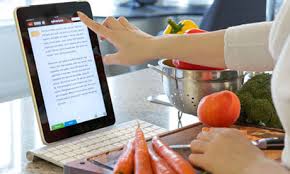
Smartphones and tablets are increasingly used as educational tools in classrooms and homes, providing new ways for experiential learning. Young Chefs is now jumping on the bandwagon. We are partnering with the CS342 class at Carleton (Mobile App Development, led by professor Jeff Ondich) to develop our lesson plans on an iPad platform. Soon, our curriculum will be available for students to snap photos, take notes, do experiments at home and in school, all with the guidance of an interactive tablet interface. The beta version will be available in June. Stay tuned!

cooking

Popping the Question: Week 2, Northfield and Faribault, MN

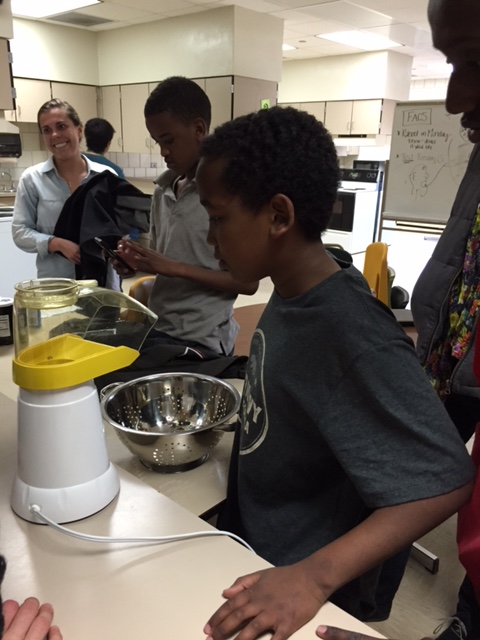
Though most of us don’t consider it when we are mindlessly chowing down on the butter soaked fluffy starch at movies, popcorn serves as the mingling ground for multiple fundamental scientific ideas. Principally, the act of popcorn popping deals with the idea of water vaporization. Popcorn is a seed containing the endosperm of the plant surrounded by the yellow-orange hull. Inside the kernel there is a significant amount of water (about 15% of the kernel is water). When the popcorn is heated, the water vaporizes and expands, which eventually exerts enough pressure on the hull so that the popcorn explodes. When this happens, it can be said that the popcorn undergoes a physical change because the chemical composition of the corn is not altered. Additionally, assuming that the water vapor does not leave the system, the popcorn should not experience a change in mass when it transitions from its kernel state to its fluffy popcorn state. To demonstrate these principles, we first popped a kernel of popcorn in a test tube over a candle and allowed the steam to escape so that they could see that there had been water in the system which vaporized. After they grasped this concept, we allowed the students to explore the concept of preservation of mass. To do so, we weighed a half cup of un-popped popcorn kernels and recorded the weights. We then had the students pop the kernels and reweigh them to see how the mass had changed. Most had predicted that the mass would decrease because they were light and fluffy once they popped. In actuality, we did see a decrease in mass, which was probably due to a combination of hungry students and the loss of water vapor. Though we didn’t address it in this lesson, it would have been relevant to discuss the concept of density.
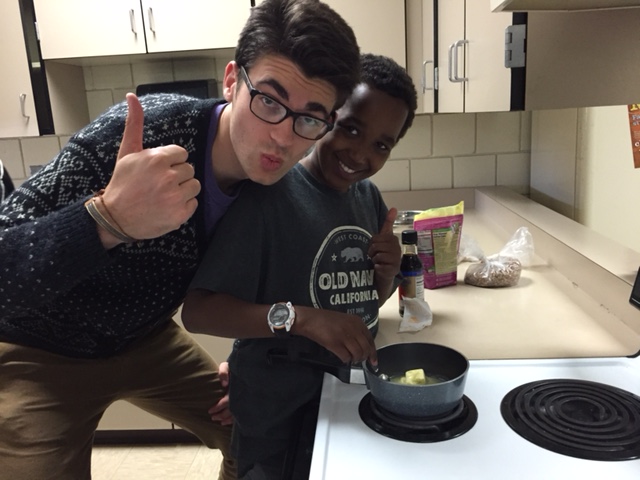
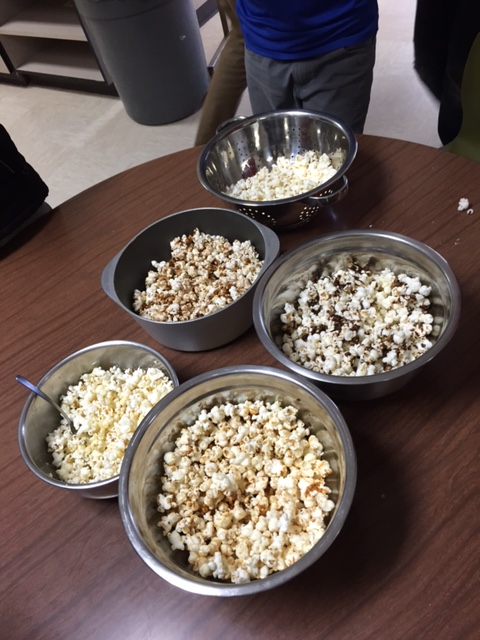
As we munched on the plain popcorn, we discussed how the popcorn was kind of bland, and how we could add different flavors to make it yummier to snack on. At Northfield Middle School, the kids then divided into four separate groups and each followed a topping recipe to spice up the popcorn a little bit. The flavors included apple pie, maple brown sugar, soy sauce-wasabi, and rosemary/garlic/Parmesan. The kids loved all of the types of popcorn, but they were especially keen on the apple pie popcorn and gobbled it all up within minutes. At Faribault we again had a fairly low turnout and so we decided to split into two groups instead of four.  Rather than adhering to a recipe, these groups focused on the concept of culinary creativity to create flavors that strayed from our recipes. They ended up with a burnt salted  caramel, a brown sugar, a Parmesan and rosemary and a “spicy spicy” (garlic, pepper flakes, wasabi and soy sauce) flavored snack. Again, the popcorn was incredibly  successful, but the students particularly enjoyed the brown sugar variety.
It is safe to say that from a culinary angle, the popcorn was an enormous hit. The strength of the lesson was only weakened by the fact that the weights of the popcorn were inconsistent so the concept of conservation of mass was not effectively taught.  Aside from this, the lesson was effective because, not only were the students eager to try the perhaps unfamiliar combinations, but they embraced the freedom and challenge of culinary creativity and wound up with incredible creations.

Written by Rebecca Fairchild ’18

IMG_2697 IMG_2700 IMG_2701 IMG_2703 IMG_2704

Young Chefs Spreads to West St. Paul, MN

As April showers begin (hopefully) to bring May flowers, they’ve also brought the newest expansion of Young Chefs: to the Dodge Nature Center in West St. Paul, MN! We’re excited to announce the newest Young Chefs Project:

The Thomas Irving Dodge Nature Center, MN (2015-Present)

The Dodge Nature Center, an environmental education and habit restoration in West St. Paul, will be incorporating our curriculum in their summer day camp, combining culinary science education with nature and agriculture-based programming.

https://i0.wp.com/www.dodgenaturecenter.org/inc/fgLogo.png

Noodling Around: Week 1, Northfield, MN

Young Chefs convened in Northfield last Wednesday after the spring break hiatus. Wednesday’s lesson called for an assortment of delicious pastas. There was homemade spaghetti, ravioli filled with pumpkin, and ravioli filled with greens and mushrooms. All these different types of pastas were topped with a delicious homemade marinara sauce.

To begin, the young chefs broke into smaller groups. One group was in charge of making the pasta dough and feeding it through the pasta roller until it was thin enough to be cut into spaghetti. Another group was in charge of filling the ravioli with their sumptuous ingredients and then pressing them and preparing them for the stove. The last group made the marinara sauce with some olive oil, garlic, red pepper flakes, sage, and crushed tomatoes. The sauce stewed until some of the water evaporated, leaving a thick yet fluid sauce.

The young chefs had fun with the hands-on cooking. They got to take turns kneading the pasta dough and by the end, many were covered with floury handprints. The sauce spattered as it was poured into the pan and the chefs excitedly tasted the sauce throughout the process. One chef called for more salt, another called for extra herbs, and a third called for the tomatoes to be crushed more thoroughly. At the ravioli station, chefs got to practice putting different fillings in the ravioli. Sometimes there was too much filling and the ravioli burst under the weight. By the end, however, the chefs had perfected their pasta proportions.

Finally, the chefs got to eat their creations. We sat around discussing what we liked, what we didn’t, what we would do differently next time. All in all, everything was very tasty.

Written by Sam Bearak ’17

Noodling Around: Spring Term Week 1, Faribault, MN

For the first Young Chefs lesson of the term, we decided to explore one of the most loved and most consumed foods in our diets- pasta. Not only is pasta delicious, but it’s also incredibly versatile and lends itself well to culinary creativity. For this lesson, we did not follow a lesson plan that dealt specifically with the scientific component of the cooking. Rather, using the myriad of pasta possibilities available, we explored the wealth of possibility in food and cooking.
With the beginning of the term, there was some confusion about the program participants, and the group ended up being very small— only three students. Though we had planned for more students, this gave us a unique opportunity to really get to know the students that we were working with and ensured that they each had a large amount of responsibility for the cooking. Though we were initially slightly disappointed with the turn-out, this was really the only hitch in the plan and it ended up being a fun break from the typical larger group setting.
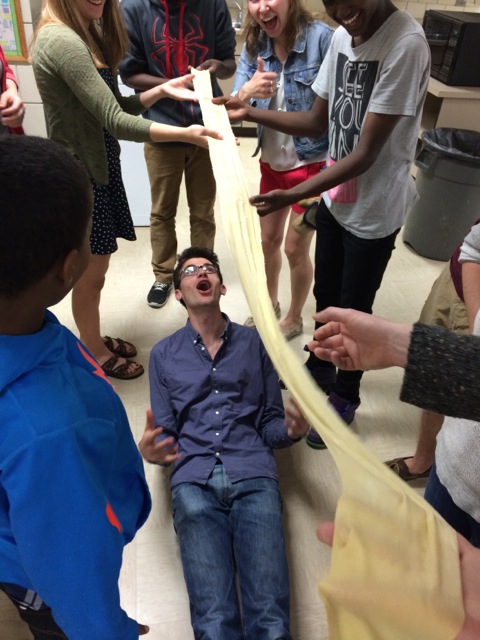
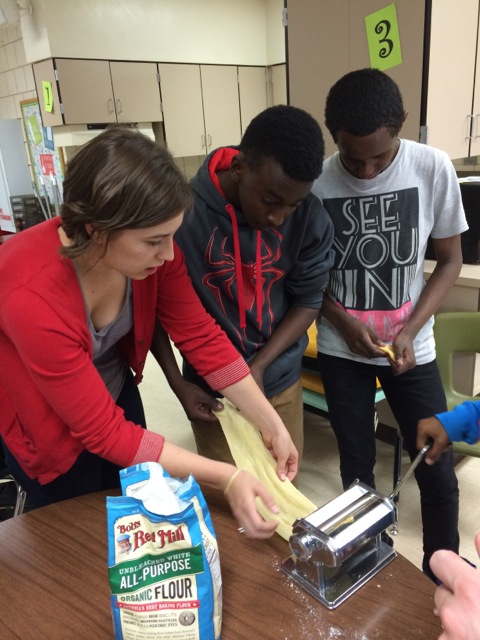
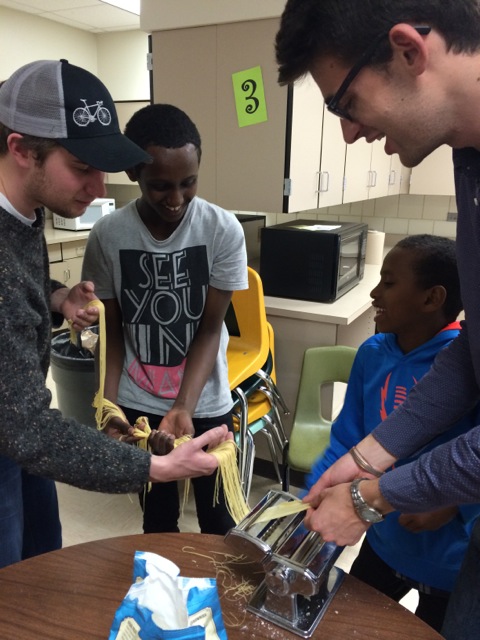
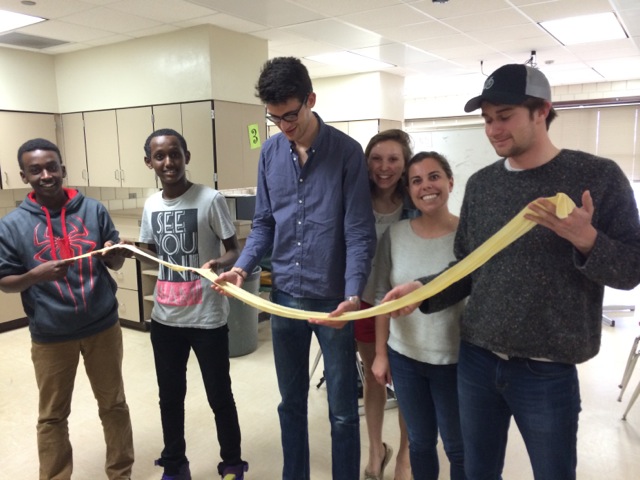
Before we arrived, we had prepared a standard batch of pasta dough to ensure that we had enough time to make toppings and roll and cut the pasta. First, we fed small chunks of pasta dough into the pasta machine and cranked each through multiple times to gradually flatten and stretch the dough out. As the boys enthusiastically cranked the dough through, they marveled at the long sheets as they emerged from the machine. As they were working their biceps cranking sheet after sheet of dough through the machine, they speculated about the composition of the dough and asked about the role of carbohydrates and different grains that they noticed were mentioned on the flour bag. Once the sheets were rolled out and had dried for a couple of minutes, we began the ultimate test of pasta prowess— feeding the long sheets through the pasta cutting attachments without breaking the noodles as they came out. It turned out that they were pasta masters and had no problem cutting noodles, even if they were well over six feet long!
As the noodle formation was underway, a group of volunteers sautéed some mushrooms, garlic and spinach which would be used for our next type of pasta— ravioli. To make the ravioli, we used wanton wrappers which we filled with combinations of ricotta, mushrooms, spinach, mozzarella and goat cheese. As we filled the ravioli, we stressed the value of creativity and ingenuity in cooking. Eventually, we had created dozens and dozens of ravioli and significant heaps of fettuccine and spaghetti. Once they were cooked, we tossed the plain noodles with brown butter, served the ravioli plain, and dug into our delicious pasta feast.
From rolling out the dough as fast as they could, to measuring the noodles against the tallest person in the room, to sampling the mystery-flavored raviolis, the boys were extremely engaged in and excited by the lesson and we deemed it a resounding success. Over the course of the lesson, the pasta stayed true to its reputation— an easy, delicious and creative dish that everyone loves.

Written by Rebecca Fairchild ’18

IMG_5518IMG_5507IMG_5512IMG_5515

Young Chefs on CBS Minnesota Radio!

cbsminn

Thanks to all the volunteers, organizations, and people who have made this possible!!

Listen to co-founder Vayu Maini Rekdal’s interview on CBS Minnesota on “Off the Menu,” by James Beard award-winning journalist and Carleton College alumn Dara Moskowitz Grumdahl. Between minutes 17-24 you can hear him talk about the Young Chefs Program: From Cooking to Science,FireBellies, and growing up cross-culturally.

http://minnesota.cbslocal.com/show/off-the-menu-with-dara-moskowitz-grumdahl/#

Young Chefs Announces Summer Program in Northfield, MN: Two Paid Positions for Gardening, Cooking and Science

We recently announced our launch of our new garden launched together with Kitchen Garden Laboratory at the Middle School in Northfield, MN. We are now proud to announce our launch of a summer program that will incorporate gardening, cooking, and science to provide underserved youth with rewarding learning experiences in the kitchen, classroom, and beyond. Specifically, we are partnering with the Northfield Middle School Summer Plus program to hire two site assistants that will work to actively create and teach science, cooking and garden curriculum over the summer, in addition to helping with day-to-day tasks at the school and mentoring and supporting the Middle School students in their normal academic activities.

All site assistants will spend 1-2 hours working each morning tending to, and teaching in, the Northfield Middle School  Garden and spend 3-4 hours leading groups of middle school students through daily activities at Carleton with the Kitchen Garden Laboratory, Young Chefs, and other on-campus organizations involved with the Summer Plus Program. Site assistants you will also join our team to develop the schoolyard garden this spring! Such a program has never existed in Northfield before, so if you are interested in taking it on, you can truly make it your own.

Deadline to Apply: March 25, 2015

contact purnellc@carleton.edu for questions

Apply at Northfield School District website (Job ID 1876) scroll down to where it says, “Targeted Services BLAST site assistant” http://nfld.k12.mn.us/departments/hr/?category=Community+Services+Positions

June 24thto August 6th, M-Th: 9:30am-3pm, $11/hour, 20 hours/week
Training on June 23rd
If you are a Carleton College student, you can easily work Lighten Up or reunion between end of classes and start of program!

6K3A3316